





























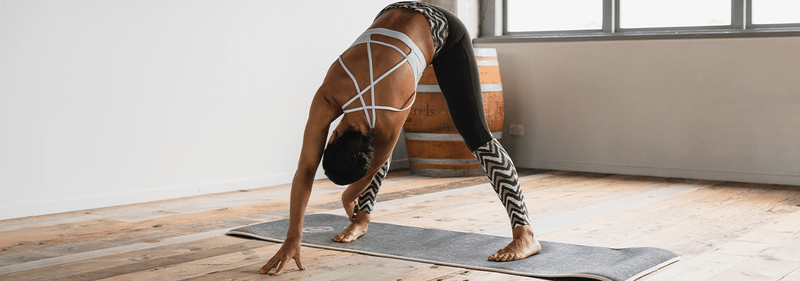
World Yoga Day is a good hook every year to finally start your own yoga routine. And it's not only on World Yoga Day on 21 June that we should roll out our mats, yoga works every day! And so that you too finally find your personal yoga routine, today we want to hand you a few tips so you never miss a yoga session again! Be sure to keep reading if you too want to find more inner calm, peace and muscle strength thanks to daily yoga sessions!
What is yoga?
Yoga is more than just a workout that enjoys great popularity thanks to YouTube. Yoga originated as a philosophical teaching over 7000 years ago in India and is an integral part of the traditional Indian healing art of Ayurveda. While Ayurveda focuses on physical and mental well-being, yoga practices provide mental and spiritual well-being. Yoga practices such as asanas (yoga exercises) promote a strong, flexible and healthy body.
Yoga practices include asanas (physical exercises and movement sequences in a yoga flow), niyama (rules of conduct), meditation (mental exercises for consciously directing attention) and asceticism (exercises for self-discipline in thinking, willing and one's own behaviour).
What is yoga good for?
The yoga practices that are especially popular in Germany are above all asanas and meditations.
By practising exercises for strength, flexibility or mobility as well as awareness, the two components of body and mind are meant to be united. Optimal breathing during the exercises, for alternately tensing and relaxing the muscles, plays a major role here. Not only are the outer muscles of the core strengthened, but also the deep, inner stabilising muscles of the pelvis, abdomen and back: the trunk muscles.
Beyond the yoga sessions, regular practice is meant to lead to more mindfulness, awareness and balance on the mental level. From a physical point of view, the strength exercises strengthen your muscles, be they standing exercises or dynamic sequences of several poses (also called flows). It's important to stress that there is not “the one yoga”! The term “yoga” comes from Sanskrit and simply means the unity of body and mind: how this is ultimately achieved is left open. So there are many different yoga styles with different demands and focuses.
Who can do yoga?
Today there are numerous yoga studios that have tailored their classes to every yoga level. But beginners and advanced yogis can also easily practise yoga at home. Thanks to numerous YouTube videos and the frank app, you can start at any time and feel your way towards your favourite yoga practice.
If you are the type who likes to dive deeper into the subject, we definitely recommend visiting a yoga studio every now and then. Trained yoga teachers can improve your poses and help you confidently try new asanas and find your own yoga style.
Ever heard of cross-training? The term describes doing at least 2 different sports as a sports routine to improve performance and balance out deficits caused by one-sided strain. On top of that, cross-training brings variety and fun to your fitness routine! LeBron James, Cristiano Ronaldo and Tiger Woods rely on Pilates, which is closely related to yoga.
Your daily yoga routine in 3 steps
Thanks to the many different yoga styles, there are numerous ways to make your own yoga practice varied and to fit yoga sessions into every day.
Mindful treatment of your own body and mind is the number one rule in yoga, and so the different yoga practices also let you adapt your yoga session to how you feel that day. Bursting with energy? Then try a sweaty flow. Feeling rather tired and drained? Treat yourself to a break. Mindful stretching or a relaxing meditation can bring calm and new strength.
With the following three tips we help you finally fit your yoga routines into your everyday life.
1. Find your place of calm
Even if energising asanas don't have much to do with calm and sitting still, at the end of every yoga session you are invited to find inner calm in a final relaxation, "Shavasana", and to feel how the finished session feels in your body. In these moments you don't want anyone to flop down on the couch next to you, rummage in the drawers or step over you. To find relaxation at the end, you should pick a fixed place where you can practise your daily routine without being disturbed.
2. Strengthen your mindset
As with all new habits, you should firm up your plan to build a yoga routine in your head. As we already mentioned in one of our recent blog posts on bad habits, the following steps apply to new habits:
- Your habit of practising yoga daily must be clearly defined.
Fix the place, room and time to hold yourself accountable. It can also help to put the appointment firmly in your calendar and set a reminder. - Your habit of practising yoga daily must be easy to do.
Don't resolve at the start to spend 45 minutes on the mat every day or to meditate for half an hour. A short yoga session of 20 minutes or 5 minutes of meditation is easy to do and can already achieve great things. - Your habit of practising yoga daily must be obvious.
You've decided to practise yoga every morning after getting up? Then roll out your mat the evening before and set up your laptop or tablet with the yoga video. That way you are reminded of your plan straight away and can get started.
3. Tell others about your plan
Even if you are more the type who sorts things out with yourself and doesn't want to reveal too much, it can help to share your plan with friends. On the one hand, your friends are sure to be interested in your plan or want to join in. (Developing new routines together can bond and motivate!) On the other hand, you hold yourself even more accountable to follow your words with actions. Don't put yourself under pressure, see it rather as a gentle nudge onto your soft yoga mat. ;)


