Updated: October 2026
In short: A smoothie keeps the fibre of the whole fruit, a juice doesn't, which is why a smoothie is usually more filling. Cold-pressed describes the pressing method without heating; freshly squeezed refers to the moment of preparation. The NHS advises limiting juice and smoothies together to 150 ml a day, because sugar is released when fruit is broken down. Neither is healthier than whole fruit and vegetables. As of: October 2026.
The terms are confusing: what's the difference between cold-pressed, freshly squeezed and a smoothie? Here's an honest comparison.
What do cold-pressed, freshly squeezed and smoothie mean?
Cold-pressed means the fruit or vegetables are pressed mechanically without the temperature rising significantly. Freshly squeezed describes juice made right before you drink it. A smoothie, on the other hand, isn't pressed but blended, so the pulp and fibres stay in the drink.
The terms aren't mutually exclusive: a cold-pressed juice can be freshly squeezed or come from a bottle. What matters is what happens afterwards, for example high-pressure processing (HPP) to extend shelf life. You can read more about the process in the article What Does HPP Juice Mean?
A rule of thumb that makes everyday life easier: the more fibre in the glass, the more it's a food; the clearer it is, the more it's a drink. That's not a judgement, just a help for deciding when to drink what. A clear juice quenches thirst and delivers vitamins, a thick smoothie fills you up.
What is healthier: juice or smoothie?
From a nutrition point of view, the smoothie usually has the edge, because the fibre is retained. The NHS says the same about both: blending and pressing releases sugar, which can harm teeth, and the total amount should be limited to 150 ml a day. Healthline notes, using pineapple juice as an example, that juice contains little fibre and a lot of sugar.
| Criterion | Cold-pressed juice | Smoothie | Freshly squeezed juice |
|---|---|---|---|
| Fibre | greatly reduced | largely retained | greatly reduced |
| Satiety | low | higher | low |
| Sugar | released | released, fibres balance it out a little | released |
| Vitamins | Loss through light and air possible | as with juice, drink quickly | freshest |
| Shelf life | days to weeks, depending on the process | usually the same day | the same day |
The vitamin row is a qualitative assessment, not a measurement: we don't have figures from verified sources for it.
How much of either makes sense?
The NHS is clear: no more than 150 ml per day in total from fruit juice, vegetable juice and smoothies, and regardless of the amount, it only counts as one portion of your 5 a day. One portion of fruit or vegetables is 80 g.
A worked example: a 330 ml juice is more than double the 150 ml limit. If you want to follow the recommendation, split the bottle over two days or drink it as part of a meal. The NHS also recommends drinking juice and smoothies only with meals, because sugar between meals is harder on your teeth.
| Drink | Amount | How much counts towards 5 a day? |
|---|---|---|
| Juice 150 ml | 150 ml | 1 portion |
| Juice 330 ml | 330 ml | still max. 1 portion |
| Smoothie 250 ml | 250 ml | still max. 1 portion |
| 1 apple (medium) | 1 piece | 1 portion |
A simple rule helps in everyday life: count juice and smoothie together, just as the NHS does. If you have a smoothie in the morning and a juice at lunch, you've usually already exceeded the daily amount. Work out which drink matters more to you, and drop the other.
What does HPP do for cold-pressed juice?
For frank. juices we use cold-pressed plus HPP, a high-pressure process without heating. The juices are not pasteurised, are vegan, and have no added sugar and no preservatives. That means they keep for about 14 days after delivery when stored at 2 to 8 degrees. Freshly squeezed juice from your kitchen counter keeps for much less time.
What HPP doesn't change: the juice still has little fibre, and the sugar comes from the fruit. That's the physics of pressing and applies to every juice. You can read a comparison with whole fruit in the article Eating Fruit vs. Drinking Juice. You can read how pasteurised juices differ in the article Pasteurisation: Pros and Cons.
Which myths about juice and smoothies aren't true?
There are claims about juices going around that don't hold up. The table puts them in context.
| Claim | Assessment |
|---|---|
| Cold-pressed is automatically healthier | The process tells you something about how it's made, not about sugar and fibre. |
| Juice replaces fruit | According to the NHS, juice counts as only one portion in total. |
| Smoothies have no sugar | Sugar is released when fruit is blended, even without added sugar. |
| The more, the healthier | The NHS limits the amount to 150 ml a day. |
| No added sugar means sugar-free | Fruit sugar is still in there. |
There's no scaremongering behind this. A glass of juice or a smoothie is perfectly fine if you see it as a treat and a small extra. You can read more about the role of fruit sugar in the article Is Fruit Sugar Healthy?
When does which drink fit into your day?
Choose by situation, not by ideology. The smoothie fills you up, the juice is light and quick, and the freshly squeezed one is the version for at home.
- Breakfast: a smoothie with oats or yoghurt keeps you full for longer.
- On the go: chilled juice in a bottle is practical.
- At home with time: freshly squeezed, drink straight away.
- Between meals: water is better, for the sake of your teeth.
- With meals: a small glass of juice fits.
Many older articles help with putting this in context, for example The Juice Guide: Everything About Fresh Juices.
How do you make a good smoothie without the sugar trap?
Go for vegetables and protein rather than just fruit. A balanced base keeps you full for longer and delivers less sugar per glass.
| Building block | Example | Function |
|---|---|---|
| Liquid | Water, unsweetened plant milk | Base |
| Vegetables | Spinach, cucumber | little sugar, volume |
| Fruit | Berries, banana | Sweetness |
| Protein or fat | Yoghurt, nuts, seeds | Satiety |
Count the amount towards the daily limit of 150 ml that the NHS gives for all juices and smoothies. If the smoothie replaces a meal, it's no longer a drink but food. Then it's the overall picture of your day that counts.
Feel free to try both. If you stay full for a long time after a smoothie, that's a plus. If you like a clear juice with your food, it's just as welcome. What matters is that you keep an eye on the amount.
Pairs well with frank.
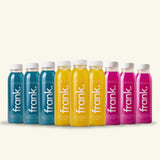
If you'd like to get to know cold-pressed juices, start with the Juice Sample Set, a selection of our juices for 49.50 EUR (as of October 2026). The bottles hold 330 ml and keep for about 14 days after delivery when chilled. Split them up if you want to stay within 150 ml a day.
You might also like
- Eating Fruit vs. Drinking Juice - Which Is Healthier?
- The Ultimate Juice Guide: Everything You Need to Know About Fresh Juices!
- What Does HPP Juice Mean and How Does the Process Work?
Frequently asked questions about cold-pressed, smoothie or freshly squeezed
Is a smoothie healthier than juice?
It usually delivers more fibre and fills you up better. The NHS limits both together to 150 ml a day.
What does cold-pressed mean?
The fruit or vegetables are pressed mechanically without the temperature rising significantly. The juice is made shelf-stable by HPP, for example.
Is freshly squeezed juice better than shop-bought?
It's the freshest, but only keeps for a short time. Chilled, high-pressure-treated juice keeps longer, around 14 days at frank.
How much juice a day is healthy?
The NHS recommends no more than 150 ml of juice and smoothies together, ideally with meals.
Does a juice replace a portion of fruit?
Partly: juice and smoothies together only count as one portion of your 5 a day, regardless of the amount.
Note: This article is for general information and does not replace medical or therapeutic advice. If you have symptoms or pre-existing conditions, are pregnant or take medication, please speak to your doctor first.