Updated: October 2026
In short: Sage tea is traditionally used for throat complaints and sweating. Studies are looking at sage for hot flushes and memory performance, but according to the NCCIH the evidence is small. Because of the compound thujone, you shouldn't drink sage tea in large amounts or long term, and caution is advised during pregnancy. As of: October 2026.
Sage is in many kitchens and in almost every home medicine cabinet. Here's what there is to the plant, how to make the tea properly and when you're better off skipping it.
What does sage tea do?
Sage tea is traditionally used to soothe the throat and mouth, for heavy sweating and for digestive complaints. There are hardly any robust studies on this. The US centre NCCIH notes that little research on sage exists, so no clear conclusions can be drawn.
What remains are indications from smaller investigations. It's worth reading them for what they are: a reason to research more, not a promise. If you like sage tea, you can enjoy it as an herbal tea without hoping for miracles.
Many people have a good experience with the warm tea in the evening when the throat is dry. That's partly simply due to the warmth and the drinking, not to the sage alone. This distinction matters if you want to judge what the tea actually does.
Does sage help with menopause and memory?
Studies are looking at sage for hot flushes during menopause. According to the NCCIH, common sage may reduce their frequency. There is also research on memory: in healthy people, some studies showed better performance, but the evidence is limited. A few studies also look at blood lipid levels.
| Area | Status according to the NCCIH |
|---|---|
| Hot flushes | first indications, little data |
| Memory | individual studies, limited evidence |
| Cholesterol | few studies |
| Safety | used for up to 8 weeks in studies |
Note: many of these studies use extracts or capsules, not tea. What a tea does can't be derived from them.
Healthline also mentions indications on blood sugar in type 2 diabetes and on oral health, but stresses that much of it comes from animal or lab studies with extracts. If you take diabetes medication, you shouldn't use sage on your own to lower blood sugar.
What is thujone and why does it matter?
Common sage contains thujone. According to the NCCIH, this compound can be toxic in large amounts, which is why sage can be unsafe in high doses or with long-term use. In culinary amounts, sage is considered safe.
With tea, the amount is manageable: Healthline cites around 4 to 11 mg of thujone per litre of tea and writes that several cups a day are safe. Sage essential oil, on the other hand, is highly concentrated and doesn't belong in the body. I deliberately stay more cautious: one to two cups a day over a few days is enough, for example for a sore throat. If you'd like it more often, alternate with other herbal teas, because the content varies depending on the plant and steeping time.
| Form | Thujone assessment |
|---|---|
| Tea (approx. 1 litre) | around 4 to 11 mg according to Healthline |
| Culinary herbs | safe according to the NCCIH |
| Essential oil | highly concentrated, do not ingest |
| High doses or long-term use | possibly unsafe according to the NCCIH |
Can you drink sage tea during pregnancy and breastfeeding?
During pregnancy, the NCCIH advises caution because thujone could be harmful. Discuss sage with your doctor first. If in doubt, another tea is the relaxed choice.
For breastfeeding, I'm not aware of a clear statement in the sources I checked. If sage is drunk during this phase, it's best done after consulting your midwife or doctor. This also applies to people with seizures and to anyone who regularly takes medication. Interactions are possible and can be clarified in a short conversation.
How do you prepare sage tea properly?
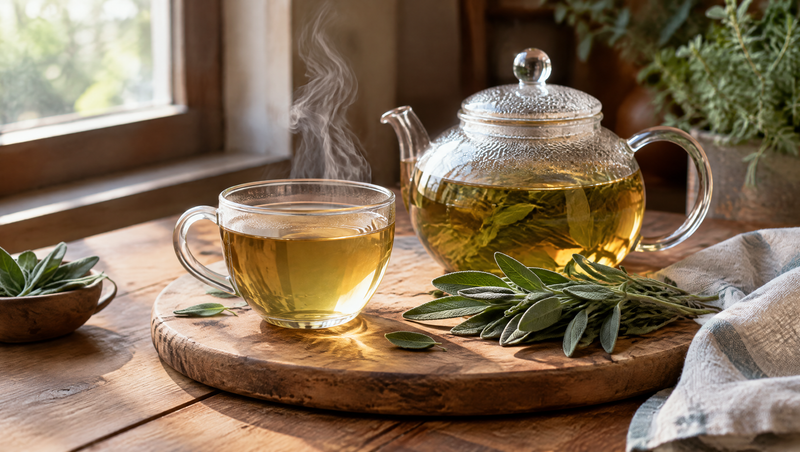
Pour 200 ml of hot water, no longer at a rolling boil, over a teaspoon of dried sage leaves (or a tablespoon of fresh leaves). Let the tea steep covered for about 5 minutes and strain it. Covering keeps the essential oils in the tea.
- Fresh leaves give a milder aroma.
- Lemon or a teaspoon of honey rounds off the tart flavour; for children under one year old, no honey.
- Drunk cold, it's an alternative to gargling, but not for swallowing in large amounts.
A worked example: at two cups a day, you need about 2 teaspoons of sage, so roughly 2 grams. A 100 g pack would last around 50 days that way. That shows how little you need, and that sage is more of a herbal boost than an everyday drink.
Which teas work as an alternative in everyday life?
If you don't want to drink sage every day, blends where it's only one of several herbs are a good option. The amount per cup is then small, and the flavour stays varied.
You can read about how herbal teas fit in while fasting and in everyday life in the article Tea for Fasting. You'll find background on plant compounds in Secondary Plant Compounds and Their Effects.
An example day: a ginger tea in the morning, water at lunch, an herbal blend in the afternoon, a calming tea in the evening. That way sage appears at most once a day.
Herbal blends also have the advantage that you get different flavours without a single herb dominating. Try what you like, and pay attention to how you tolerate it.
When should you see a doctor for a sore throat?
Sage tea can be a pleasant ritual for a mild scratchy throat. If a sore throat lasts longer than a week, a fever above 38.5 degrees develops or swallowing becomes very difficult, it needs to be checked by a doctor. The same applies with shortness of breath, blood in your phlegm or if tonsillitis is suspected.
A tea doesn't replace treatment. It's an herbal drink that also provides warmth and fluid, and that alone often feels good.
For children, pregnant women and people with pre-existing conditions: better to ask once more than once too few. If you suspect an allergy to mint-family plants, which sage belongs to, you should also be careful and first try the tea in a small amount only. If you break out, stop the tea and get advice.
Pairs well with frank.
Sage is also one of the ingredients in the organic herbal tea Happy Stomach Tea: linden blossom, aniseed, fennel, chamomile, ginger and sage. Loose, 100 g pack from 15 EUR (as of October 2026), which is about 20 to 33 cups. Since sage is only part of the blend here, the amount per cup stays small. During pregnancy, please talk to your doctor first here too.
You might also like
Frequently asked questions about sage tea
How often can you drink sage tea?
A cautious guideline is one to two cups a day for a few days. Healthline considers several cups safe, but the NCCIH warns against high doses and long-term use because of the thujone. Alternate with other teas.
Is sage tea allowed during pregnancy?
The NCCIH advises caution during pregnancy. Talk to your doctor first and, if in doubt, choose a different tea.
Does sage tea help against sweating?
It's traditionally used for that. Studies are looking at sage for hot flushes, but according to the NCCIH the evidence is limited and mostly comes from extracts.
What is thujone?
A compound in common sage that, according to the NCCIH, can be toxic in large amounts. In culinary amounts, sage is considered safe.
How long does sage tea need to steep?
About 5 minutes, covered, so the essential oils stay in the tea.
Can I drink sage tea with medication?
Interactions are possible. If you take medication regularly, ask at the pharmacy or your doctor first.
Note: This article is for general information and does not replace medical or therapeutic advice. If you have symptoms or pre-existing conditions, are pregnant or take medication, please speak to your doctor first.