Updated: October 2026
In short: Yes, there are healthy ready meals, but you have to look closely. A short ingredient list with recognisable foods, little salt (ideally under 1.0 g per 100 g), little sugar and as few additives as possible are the most important features. Vegetables and legumes should be near the front of the ingredient list. As of: October 2026.
There isn't time to cook every day. Ready meals save time but vary greatly in quality. With a few criteria you'll find the good ones.
Are ready meals unhealthy in general?
No, not in general. What matters is how heavily processed the product is and what's in it. A dish made of vegetables, legumes and spices is something different from a frozen pizza with lots of salt, fat and additives.
Ready meals usually become problematic through high salt and sugar contents, cheap fats and long ingredient lists with flavourings, flavour enhancers and emulsifiers. Anyone who lives mainly on them often takes in too little fibre and fresh food. You'll find an overview of typical nutrition mistakes in The German diet: what are we doing wrong?
What do you look for when buying ready meals?
Turn the pack over and read the ingredient list and the nutrition table. Ingredients are listed by weight in descending order; what comes first is what's in it most.
- Short ingredient list: The fewer ingredients and the more of them you know from your own kitchen, the better.
- Vegetables first: Then the dish really consists of them.
- Salt: The DGE recommends no more than 6 g of salt a day. A ready meal shouldn't already contain half of that.
- Sugar: Savoury dishes hardly need added sugar. Watch for glucose syrup, dextrose, maltodextrin.
- Fat: High-quality oils (rapeseed, olive) are better than hardened fats or palm oil.
- Additives: Yeast extract, flavourings, flavour enhancers and many E numbers are signs of heavy processing.
Which values are good for ready meals?
As a rough guide (per 100 g) you can follow the traffic-light labelling from Britain, which isn't mandatory in Germany but helps well:
| Criterion | Low / good | High / critical |
|---|---|---|
| Salt | up to 0.3 g | over 1.5 g |
| Sugar | up to 5 g | over 22.5 g |
| Saturated fat | up to 1.5 g | over 5 g |
| Fibre | over 3 g | under 1 g |
| Protein | over 5 g (meat, legumes) | under 2 g |
The Nutri-Score on the front can be a guide, but only compare products in the same category. It does not replace looking at the ingredient list.
What does a checklist for shopping look like?
Here is a compact overview you can go through in the supermarket:
| Question | Good sign | Warning sign |
|---|---|---|
| How long is the ingredient list? | under 10 ingredients | over 20 ingredients |
| What comes first? | Vegetables, legumes, wholegrain | Sugar, starch, fat |
| How much salt? | under 1 g per 100 g | over 1.5 g per 100 g |
| Additives? | few or none | Flavourings, flavour enhancers, colourings |
| Which fat? | Rapeseed, olive oil | Palm fat, hardened fats |
| How big is the portion? | Per-portion information is realistic | very small portion so the values look better |
Also note the portion size: some manufacturers calculate the nutritional values for a portion that barely fills you up.
What healthy alternatives are there to ready meals?
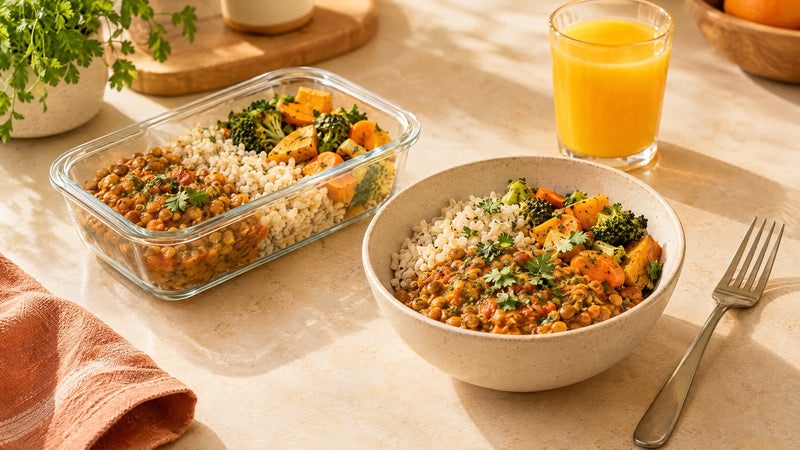
The middle path between cooking yourself and ready meals often works best: prepare ahead, freeze, combine basics.
- Meal prep: At the weekend, pre-cook 2 to 3 dishes and freeze in portions. How that works is explained by How does meal prep work? and Meal prep for beginners.
- Frozen vegetables and legumes from a jar: With rice or pasta, a complete meal in 15 minutes.
- Ready-made soups: With a short ingredient list they are a quick warm meal, and the criteria above can be easily applied to them. You'll find a selection in the Soup collection from frank.
- Homemade basics: A big batch of tomato sauce, stew or dal keeps in the fridge for 3 to 4 days.
How do you put together a balanced meal from ready-made products?
If you do reach for a ready meal, you can upgrade it in a few steps.
- Add a handful of fresh or steamed vegetables (spinach, peppers, broccoli).
- Add protein: an egg, cottage cheese, chickpeas or tofu.
- Season with herbs, lemon or chilli instead of extra salt.
- Have a salad or a piece of fruit with it.
- Don't add more salt, as ready meals are usually salted enough already.
That turns the quick dish into a meal with more fibre and vitamins.
When do ready meals make sense?
Ready meals make sense if they are an emergency plan or if they help you eat a warm meal at all. That's no problem as long as they don't become the main part of your diet.
- On stressful days, as a reserve in the pantry or freezer.
- For the office or on the go, when you'd otherwise only eat snacks.
- For people who can't cook well physically and depend on support.
As a rule of thumb: a good ready meal two to three times a week is unproblematic if the rest of the week consists of fresh food.
What does 'without additives' mean on the packaging?
This label is not uniformly protected by law, and it says little about quality, so it's worth looking at the ingredient list. 'Without additives' usually means no E numbers were used, but flavourings, yeast extract or seasonings may still be contained.
'Organic' too says something about the origin of the raw materials, but nothing about salt, sugar or fat content. Organic ready meals can therefore also be salty or high in fat. The best guidance remains the combination of ingredient list, nutrition table and your gut feeling for how heavily processed the product is.
Matching from frank.
If you'd like to try ready-made soups: in the Sample set Soups you get to know different varieties from frank. The ingredient list is on the product page each time; check it as with any other ready meal.
You might also be interested in
- How does meal prep work? This is how easily you save time
- Meal prep for beginners
- The German diet - what are we doing wrong?
Frequently asked questions about healthy ready meals
Which ready meals are the healthiest?
Dishes with a high share of vegetables or legumes, a short ingredient list and little salt do best, for example stews or soups with simple ingredients.
How much salt may a ready meal contain?
As a guide, under 1 g per 100 g counts as good, over 1.5 g per 100 g as high. Overall, adults should take in no more than 6 g of salt a day according to the DGE.
Are frozen meals better than tinned ones?
Not across the board. Frozen vegetables often retain vitamins well, but it depends on the individual product. Always compare the ingredient list and nutritional values.
Can you eat healthily on ready meals alone?
That's difficult. Even good products should be complemented with fresh fruit, vegetables and unprocessed foods.
What is a heavily processed food?
Heavily processed foods are those with many ingredients you wouldn't use in the kitchen, such as flavourings, emulsifiers or modified starch. The shorter the ingredient list, the lower the degree of processing usually is. This is a rule of thumb and not a fixed limit.
Note: This article is for general information and does not replace medical or therapeutic advice. If you have complaints, pre-existing conditions, are pregnant or take medication, please talk to your doctor first.