Updated: October 2026
In short: Lent 2027 begins on Ash Wednesday, 10 February 2027, and lasts until Easter on 28 March 2027. 40 fasting days are counted; Sundays traditionally don't count. You can give up food, but also habits like alcohol, sugar or your phone. If you want to start with a Juice Cleanse, it's best to plan it for the first days. As of October 2026.
Lent is a good occasion to change something. Here you'll find the dates for 2027, an explanation of the 40 days and a plan for starting your fast sensibly.
When does Lent 2027 begin and end?
Lent begins on Wednesday, 10 February 2027, and ends at Easter, Sunday, 28 March 2027. Easter falls on the Sunday after the first full moon of spring, which is why the date moves every year. The Protestant campaign "7 Wochen Ohne" ("7 Weeks Without") gives the period from 10 February to 29 March for 2027, so up to Easter Monday. The motto is "Probier´s mal! Sieben Wochen ohne Aber" ("Just try it! Seven weeks without 'but'").
| Date | Date 2027 |
|---|---|
| Ash Wednesday (start) | Wednesday, 10 February |
| Maundy Thursday | Thursday, 25 March |
| Good Friday | Friday, 26 March |
| Easter Sunday | Sunday, 28 March |
| Easter Monday | Monday, 29 March |
Easter falls comparatively early in 2027. That's why Lent already starts in the first half of February and not only at the end of the month. If you're planning your Juice Cleanse or a period of giving something up, you don't have forever until the start: begin preparing around a week beforehand.
The church framework differs too. The Catholic tradition knows Ash Wednesday and Good Friday as special days, while the Protestant church speaks of the Passion season and emphasises personal abstention rather than fixed food rules. So you don't have to belong to a denomination or follow a rulebook to use the time for yourself.
Why does Lent last 40 days?
The number 40 goes back to Jesus' forty-day fast in the desert. Counting runs from Ash Wednesday to Holy Saturday. Because Sundays, as days of the Resurrection, traditionally don't count as fasting days, it comes to around six and a half weeks.
The calculation for 2027: from 10 February to Holy Saturday, 27 March, there are 46 calendar days. Six Sundays fall in between (14, 21 and 28 February, and 7, 14 and 21 March). Subtract them and exactly 40 fasting days remain. If you don't want to exempt Sundays, you simply fast straight through. Both are legitimate, as it's a personal decision.
In practice: you can allow yourself an exception on Sundays, such as a shared breakfast or a piece of cake. Many people experience that as a relief and find it easier to keep up the other days. All that matters is that you decide beforehand what's allowed on Sunday, so the exception doesn't become a permanent state.
What can you give up during Lent?
Anything that has become too much in your daily life. Lent doesn't have to be about giving up food. "7 Wochen Ohne" invites you to give up habits and comforts to pause and reflect.
- Food and drink: alcohol, sweets, meat, coffee or snacks between meals.
- Media: social media, streaming or your phone after 9 pm.
- Consumption: impulse buys, delivery services, new clothes.
- Behaviour: grumbling, perfectionism, being constantly reachable.
The more specific the sacrifice, the better you stick to it. "Less sugar" is vague; "no sugar in coffee and no sweets on weekdays" can be checked. What happens if you slip up, we explain in the article Cheating During Lent.
How do you start Lent with a Juice Cleanse?
With a short cleanse as a kick-off, for example on the first three to five days after Ash Wednesday. That gives you a clear beginning before you move into the slower abstention of the remaining weeks. We describe the preparation in the Juice Cleanse Checklist.
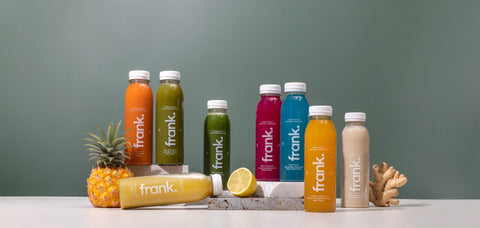
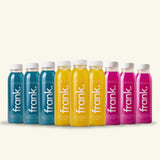
With the frank. Juice Cleanse, you drink six juices (330 ml) per cleanse day. Depending on the level, the cleanse comes to between approx. 650 and 930 kcal per day. Prices, as of October 2026:
| Duration | Starter | Medium | Pro |
|---|---|---|---|
| 3 days | €99.75 | €104.50 | €109.25 |
| 5 days | €162.75 | €172.05 | €176.70 |
At 97 g of sugar per day, the Pro level contains markedly less than the Starter at 160 g. If you're fasting for the first time, you often start with three days. The cleanse is not suitable for pregnant or breastfeeding women, children and people with a weakened immune system. In addition, drink at least one litre of still water or herbal tea. If possible, plan the cleanse days for days without big appointments, ideally without sport at your limit and without business dinners. If you work, you often choose a weekend followed by a quiet Monday. How to wind the cleanse down afterwards is in the article on breaking a fast: Guide to Breaking a Fast.
What does a plan for the whole of Lent look like?
A plan helps because first enthusiasm fades after two weeks. This suggestion is our practical idea, not a church or medical guideline.
| Period 2027 | Focus |
|---|---|
| 3 to 9 February | Preparation: cut back on coffee, alcohol and sugar |
| 10 to 12 February | Juice Cleanse to start (3 days) |
| 13 to 14 February | Rebuild gently, see What to Eat After the Juice Cleanse |
| 15 February to 21 March | Your personal abstention, take stock once a week |
| 22 to 27 March | Holy Week: consciously close your abstention |
| 28 March | Easter: break your fast calmly |
At the end of each week, write down two sentences: what was easy, what was hard? That helps more than any resolution. Also plan a fixed day each week when you consciously take time for your abstention, for example a walk instead of a series evening. Small rituals last longer than big resolutions, and Holy Week is a good moment to take stock and decide what you want to keep.
Who should not fast during Lent?
If you're ill or take medication, talk to your doctor beforehand. That applies to pregnant and breastfeeding women and people with eating disorders, diabetes, low blood pressure or kidney disease. For therapeutic fasting, the DGE explicitly points to supervision by experienced fasting doctors or trained fasting leaders, especially when medication has to be adjusted.
According to the DGE, the Ärztegesellschaft für Heilfasten recommends 7 to 10 days as standard, with a preparation day before and three refeeding days after. That is a medically supervised form. Giving up habits, on the other hand, is possible for almost everyone. You can read more about the methods in the article Types of Fasting: Which One Is Right for Me?
Matching picks from frank.
The 3-Day Juice Cleanse is a good fit for starting Lent: six cold-pressed juices per day, not pasteurised, vegan and with no added sugar, from €99.75 (as of October 2026).
You might also like
- Juice Cleanse Preparation: Checklist and Schedule for Your Juice Cleanse
- Cheating During Lent - What Is Allowed
- Types of Fasting: Which One Is Right for Me?
Frequently asked questions about Lent 2027
When is Ash Wednesday 2027?
Ash Wednesday is on 10 February 2027. That's when Lent begins.
When is Easter 2027?
Easter Sunday is on 28 March 2027, Good Friday on 26 March and Easter Monday on 29 March.
Do Sundays count during Lent?
Traditionally no. Sundays are not considered fasting days. If you want to fast straight through, you can do that, though.
Do you have to give up food during Lent?
No. Many people give up alcohol, sweets or media. Giving up food is one of many possibilities.
How long should a Juice Cleanse to start last?
Three to five days are suitable for getting started. If you have pre-existing conditions, talk to your doctor beforehand.
Note: This article is for general information and is not a substitute for medical or therapeutic advice. If you have complaints, pre-existing conditions, are pregnant or take medication, please talk to your doctor first.