Updated: October 2026
In short: Sauerkraut juice is the fermentation liquid from lactic-acid-fermented white cabbage. Fermented foods are linked to gut health, but the NHS says of probiotics that evidence exists only in individual cases, such as irritable bowel syndrome. Because of the salt, you should drink the juice in small amounts. If you have histamine problems, high blood pressure or take certain medication: check with your doctor first. As of: October 2026.
Sauerkraut juice tastes sour and salty. Here's what's behind it, what a glass does and where the catches are.
What is sauerkraut juice?
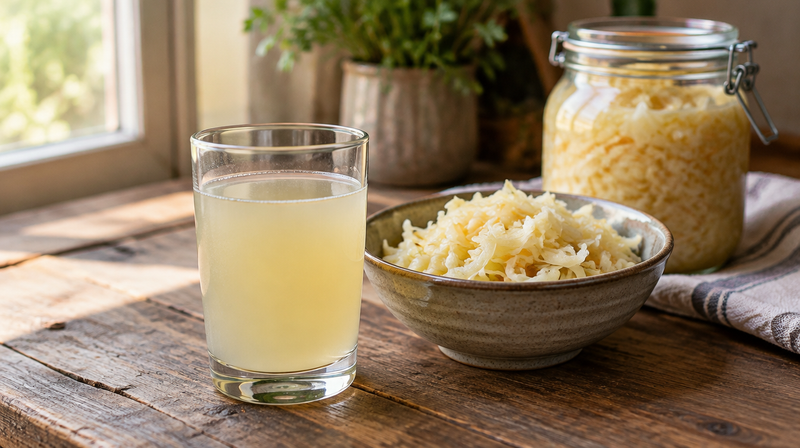
Sauerkraut juice is produced during the lactic acid fermentation of white cabbage. The cabbage is salted and ferments, lactic acid bacteria form acid, and a liquid collects. This liquid, the brine, is bottled as juice or drained from sauerkraut.
Depending on the producer, it's raw and unpasteurised or heated. In heated products, live bacteria are largely lost. The label says whether the juice was pasteurised. The amount of bacteria can't be read from the packaging.
So the taste is a clue to the salt content, but not proof of quality. A mild juice can still contain a lot of salt, a very sour one little. Decide by the label, not by your tongue. And if you prefer to make sauerkraut yourself, pay attention to hygiene and dosage when salting, following a tried-and-tested recipe.
Does sauerkraut juice help the gut?
Possibly, but it's not proven for the juice. The NHS writes about probiotics: there is some evidence that they can be helpful in certain cases, for example for symptoms of irritable bowel syndrome. But many health claims are not proven. With supermarket products, you can't always be sure that the stated bacteria actually reach the gut in sufficient amounts.
| Claim | Assessment |
|---|---|
| Fermented foods can support the gut | Studies are looking at this, evidence for the juice is lacking |
| Probiotics help with irritable bowel syndrome | some evidence according to the NHS |
| Probiotics help with eczema | no evidence according to the NHS |
| Every juice contains live cultures | not always, depends on pasteurisation |
You'll find more on the role of bacteria in the article Pro- and Prebiotics for a Healthy Gut.
In practice, that means: buy sauerkraut juice from the chilled aisle if live cultures matter to you, and read whether it's raw or pasteurised. Given the effort and the salt content, a spoonful of sauerkraut with a meal is often the easier solution. For specific complaints such as irritable bowel syndrome, medical advice remains the right path, because probiotics vary greatly depending on the strain.
How much salt is in sauerkraut juice?
Salt is used in the pickling, and it ends up in the brine. We don't give a fixed figure, because it varies by producer. The information is in the nutrition table on the label, where you can calculate it for your glass.
As a guide: the NHS recommends that adults eat less than 6 g of salt a day. A worked example: if a juice contains 0.8 g of salt per 100 ml, then 200 ml is already 1.6 g, so around a quarter of the daily recommendation. The value is purely illustrative, so check the actual value on your bottle.
If you have high blood pressure or need to eat a low-salt diet, talk to your doctor before consuming it regularly. Caution also applies with kidney disease.
What about histamine and tolerance?
Fermented foods are hard to tolerate for some people. With histamine intolerance, headaches, skin flushing or digestive complaints can occur. We have no verified source on histamine levels in sauerkraut juice, so we don't give a figure.
- Start with a sip and watch for 30 to 60 minutes.
- If you have known histamine intolerance, clarify with your doctor first.
- With bloating or diarrhoea: reduce the amount or leave it out.
- Drink it with a meal, then your stomach is better protected.
The NHS also advises seeking medical advice before probiotics if you have pre-existing conditions or a weakened immune system.
A note for context: symptoms after sauerkraut juice don't automatically mean an intolerance; often it's simply the amount. Halve it first.
How can you make sauerkraut juice taste better?
Neat, the juice is sour, salty and takes some getting used to. If you don't like it, you can mix it. Important: every addition also changes the sugar and salt in your glass.
| Mix | Ratio | Taste |
|---|---|---|
| with carrot juice | 1 part sauerkraut, 3 parts carrot | mild, sweetish |
| with tomato juice | 1 part sauerkraut, 2 parts tomato | savoury |
| with water and lemon | 1 part sauerkraut, 3 parts water | light, tangy |
| with apple juice | 1 part sauerkraut, 2 parts apple | fruity, more sugar |
You'll find details on carrot juice in the article How Healthy Is Carrot Juice? If you drink mixed drinks, count the amount towards the daily limit of 150 ml that the NHS gives for juices and smoothies.
A practical tip: don't add the juice to hot drinks. Heat destroys live cultures, if there were any. Cold or at room temperature, the character is better preserved.
How much sauerkraut juice per day makes sense?
There is no verified daily amount. We recommend a small sip up to a small glass (50 to 100 ml) with a meal and no more, mainly because of the salt. The NHS generally advises limiting fruit and vegetable juices plus smoothies to 150 ml a day; sauerkraut juice fits into this pattern.
| Time | Example |
|---|---|
| Breakfast | 50 ml sauerkraut juice neat with bread |
| Lunch | Salad with a little brine in the dressing |
| Evening | no juice, save salt |
Practical tip: brine in the dressing instead of vinegar gives acidity and flavour without you having to drink a whole glass.
Sauerkraut juice or sauerkraut: which is better?
The cabbage also provides fibre, the juice doesn't. Fibre is central to gut health; more on this in the article Fibre: Why Eat a High-Fibre Diet. So if you eat sauerkraut, you get fibre and fermentation products in one. The juice is an add-on for anyone who likes it.
For a gut-friendly diet overall, it's worth taking a look at Which Foods Are Healthy for the Gut? There you'll find more foods and ideas that don't come with a salt load.
Finally, an honest note: if the taste isn't for you, you're not missing anything crucial. A varied diet with vegetables, legumes and wholegrain does your gut more good than a single drink. Fermented food can be an addition if you like it and it agrees with you.
Start small, listen to your body and ask if you're unsure. That way the juice stays a treat and doesn't become an experiment with side effects.
Pairs well with frank.
If you like juice mild and without salt, take a look at the cold-pressed juices from frank. . The juices are cold-pressed and high-pressure (HPP) treated, vegan, with no added sugar. The boxes of 8 cost 36 EUR each (as of October 2026), keeping for about 14 days after delivery when chilled. We don't offer sauerkraut juice.
You might also like
- Pro- and Prebiotics for a Healthy Gut
- Which Foods Are Healthy for the Gut - Our Tips for a Healthy Gut Diet
- Fibre - Why Eat a High-Fibre Diet
Frequently asked questions about sauerkraut juice effects
Is sauerkraut juice healthy?
Studies are looking at fermented foods, but robust evidence for the juice itself is lacking. Because of the salt, small amounts make sense.
Does sauerkraut juice contain probiotics?
Raw, unpasteurised juice can contain live bacteria; in heated products they are largely lost. The label tells you.
How much salt is in sauerkraut juice?
It varies by producer, and the information is in the nutrition table. The NHS recommends that adults have less than 6 g of salt a day.
Who is sauerkraut juice not suitable for?
If you have histamine intolerance, high blood pressure, kidney disease or a weakened immune system, talk to your doctor first.
When is the best time to drink sauerkraut juice?
An optimal time of day isn't proven. With a meal, it's usually gentler on the stomach than on an empty stomach.
Note: This article is for general information and does not replace medical or therapeutic advice. If you have symptoms or pre-existing conditions, are pregnant or take medication, please speak to your doctor first.