Updated: October 2026
In short: Spirulina is a microalga rich in protein and chlorophyll. According to the consumer advice centre (Verbraucherzentrale), robust evidence for health effects in humans is thin, and there are no approved health claims. Typical amounts are 1.5 to 6 grams per day, usually around 3 grams. Possible side effects are digestive complaints and allergies; the quality of the product matters. As of: October 2026.
Spirulina is seen as a superfood, but the evidence is more modest than the marketing suggests. Here's what can be said, what can't and what to look out for.
What is spirulina and what's in it?
Spirulina is a blue-green microalga (more precisely a cyanobacterium) sold as a powder or tablet. The alga contains protein, chlorophyll and iron. The protein is high-quality but plays hardly any role as a supplement: at 2 grams a day, only a tiny amount adds up.
It's produced in tanks or ponds, and quality depends heavily on the operation. A special feature is the blue colour from phycocyanin. You can read more in our article What Is Blue Spirulina and What Are Its Effects?. For background on the green pigment, see Chlorophyll and Its Effects.
What effects does spirulina really have?
The honest answer: that isn't well documented. The consumer advice centre writes that there are hardly any robust human studies; the existing ones have few participants and no long control periods. There is no approved health claim under EU law for spirulina.
Studies are looking at the influence on blood sugar, blood lipids or inflammation markers, for example. The results are inconsistent and can't be applied to everyone. So if you eat spirulina, you do so more as an ingredient, not as a therapy.
You should also be critical of promises about vitamin B12: according to the consumer advice centre, around 80 percent of the B12 it contains is in a form humans can't use. For vegans, spirulina is therefore not a reliable B12 source.
In short: spirulina makes sense at most as a small addition for people who like the taste and buy a tested product.
How much spirulina per day is typical?
The amounts cited are 1.5 to 6 grams per day, usually around 3 grams. That's roughly one level teaspoon of powder. Some providers recommend much more, but there is no good basis for that.
| Information | Amount per day | Source |
|---|---|---|
| Typical range | 1.5 to 6 g | Consumer advice centre |
| Most common amount | around 3 g | Consumer advice centre |
| Recommended to start | 2 to 5 g, increase slowly | Darwin Nutrition |
| Athletic exertion | up to approx. 10 g | Darwin Nutrition |
Start small and increase over days so your stomach can get used to it. As a rule of thumb: take spirulina in the morning or at lunchtime rather than late in the evening. Some sources report it can be stimulating.
What's true about the marketing claims?
Plenty of claims about spirulina circulate online. The table puts the most common ones in context, based on the consumer advice centre.
| Claim | Status |
|---|---|
| Strong protein source | Protein is high-quality, but the daily amount is so small that the effect is minor |
| Good vitamin B12 source for vegans | About 80 percent of the B12 can't be used by humans |
| Helps with weight loss | Not proven |
| Lowers blood sugar | The EFSA saw no causal relationship that would support an approved claim |
| Approved health claims | There are none |
That doesn't mean spirulina is bad. It only means: don't expect a miracle, and don't spend much money on it.
What side effects can spirulina have?
Digestive complaints such as bloating or diarrhoea and allergic reactions are possible. An analysis by the French agency ANSES also reports individual cases with muscle and liver problems in connection with spirulina products.
The bigger issue is purity. Spirulina can contain heavy metals, cyanobacterial compounds, bacteria or microplastics, depending on how it's grown. The consumer advice centre recommends products from closed systems in Europe with quality certificates (ISO/GMP) and contaminant testing.
- Ask the manufacturer about origin and lab analyses.
- Start with the lowest amount.
- If you get itching, shortness of breath or severe stomach problems: stop taking it.
Who is spirulina not suitable for?
Spirulina is unsuitable with phenylketonuria, because the alga contains phenylalanine. The consumer advice centre also points to possible interactions with diabetes medication, immunosuppressants and blood thinners.
If you're pregnant or breastfeeding, you should talk to your doctor first. The same applies with haemochromatosis and kidney disease because of the iron content.
Thyroid and iodine: the iodine content of algae products can vary depending on type and origin, and the sources on spirulina here are not consistent. If you have a thyroid condition, such as an overactive thyroid or Hashimoto's, clarify taking it with your doctor first. That's not scaremongering, but caution while there's no clear statement.
How do you use spirulina in everyday life?
Stir the powder into water, juice or a smoothie. The natural taste is algae-like, so citrus, pineapple or banana pair well with it. You don't need to heat it, quite the opposite: add it at the end.
A worked example shows how little it is: 3 grams of spirulina provide about 2 grams of protein. An egg has around 6 grams. So spirulina doesn't replace a protein source, it only complements at best.
If you don't fancy the powder, there are ready-made blends. You can find out which foods provide good nutrition overall in the article Secondary Plant Compounds and Their Effects.
Is spirulina worth it for you?
If you like the alga and can find a clean product, there's little against small amounts for healthy adults. If, on the other hand, you take medication, are pregnant, breastfeed or have a pre-existing condition, a conversation with your doctor is the first step.
A simple example day: 2 grams in a smoothie with banana and orange in the morning, a glass of water with it, and normal meals with plenty of vegetables over the day. You don't need more. Much more important than any alga are sleep, exercise and a diet with vegetables, legumes and wholegrain. Spirulina is an extra, not a foundation.
And if you notice no difference after three weeks, that's completely normal. That's not down to you, but to the fact that the effect simply isn't well documented.
Pairs well with frank.
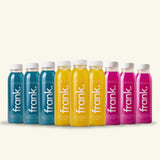
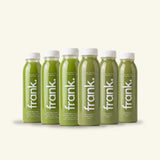
If you'd rather drink spirulina than stir it in: in our juice The Ocean spirulina and lemongrass are combined, cold-pressed. The juice is vegan, has no added sugar and keeps for about 14 days when chilled; the box of 8 starts at 36 EUR (as of October 2026). It doesn't replace a dietary supplement and isn't a therapy, but a drink for in between.
You might also like
- What Is Blue Spirulina & Its Effects?
- Chlorophyll and Its Effects
- Secondary Plant Compounds and Their Effects
Frequently asked questions about spirulina
Is spirulina healthy?
Spirulina contains protein, chlorophyll and iron. Health effects are poorly documented in humans, though, and there are no approved health claims. Spirulina can be part of a varied diet, but doesn't replace one.
How much spirulina can you take per day?
Typical amounts are 1.5 to 6 grams per day, usually around 3 grams. Start low and increase slowly. Without medical advice, avoid the much higher amounts some providers cite.
Can spirulina affect the thyroid?
The sources are not consistent, and the iodine content of algae varies. If you have a thyroid condition, talk to your doctor before taking it.
Is spirulina a good source of vitamin B12?
No. According to the consumer advice centre, a large part of the B12 it contains can't be used by humans. Vegans should secure their B12 another way.
How do I recognise a good spirulina product?
Look for cultivation in closed systems in Europe, quality certificates such as ISO or GMP and lab analyses for heavy metals and contaminants.
Can I take spirulina during pregnancy?
You should clarify that with your doctor first. Because of possible contaminants and a lack of data, restraint makes sense.
Note: This article is for general information and does not replace medical or therapeutic advice. If you have symptoms or pre-existing conditions, are pregnant or take medication, please speak to your doctor first.