In short: "Flushing out waste" in the sense of eliminating harmful substances is not scientifically proven. Your liver, kidneys, gut and skin already take care of metabolism and excretion around the clock on their own. A juice cleanse is therefore not a miracle cure, but a mindful break: a few days without sugar, alcohol and heavily processed food, with cold-pressed juices, rest and a real reset for your eating routine instead.
- From a medical point of view, there are no "slags" (waste deposits) building up in the body.
- Your metabolic organs (liver, kidneys, gut) work reliably even without a cleanse.
- The real benefit of a juice cleanse: a mindful pause, less sugar/alcohol, more awareness of your eating behaviour.
- State of the research: there is no evidence for "flushing out waste", but there are indications for the positive effects of a mindful break.
- Sensible length: 3 day juice cleanse for beginners, 5 day or 7 day juice cleanse for the experienced.
- Not suitable during pregnancy, with eating disorders, diabetes or kidney conditions, please check with your doctor.
What do "cleansing" and "flushing out waste" actually mean?
"Cleansing" is a popular word for a body reset, and in advertising it stands for teas, powders, cleanses and juices that are meant to free the body of harmful substances. "Flushing out waste" makes the same promise: supposedly deposited "slags" are to be eliminated. Both terms are not protected and are interpreted freely, so behind "cleansing" there is sometimes a pure marketing promise and sometimes a sensible, mindful change of diet.
The distinction matters: the body really does take care of metabolism and excretion, but entirely without a cleanse. What a juice cleanse can do is something different, and that's exactly what we look at here, honestly and based on the research.
Are there "slags" in the body?
No. The term "slag" originally comes from metalworking: it's the residue left over when smelting. Applied to the human body it's an image, not a medical fact. There is no scientific evidence that "slags" build up in a healthy body that would need to be actively eliminated. The consumer advice centre (Verbraucherzentrale) also makes it clear: an accumulation of harmful substances or "slags" cannot be demonstrated in the bodies of healthy people.
Fact: There are no "slags". Liver, kidneys and gut take care of excreting metabolic end products, continuously and independently of any cleanse.
What does science say about juice cleanses?
Honestly: there is no scientific proof that cleanses remove harmful substances from the body. A much-cited critical review by Klein & Kiat (2015) in the Journal of Human Nutrition and Dietetics concluded that there is hardly any reliable clinical evidence for cleansing diets; the few studies are methodologically weak and have very small numbers of participants. The Verbraucherzentrale also classes many cleansing products as unnecessary: some merely have a dehydrating effect, not a cleansing one.
More interesting is what can be measured in the body during a short juice phase. In a small study by Henning et al. (2017, Scientific Reports), 20 healthy adults drank only vegetable and fruit juices for three days. The result: the composition of the gut microbiome shifted measurably, nitric oxide in the blood rose clearly and a marker for oxidative stress (malondialdehyde) fell by around a third. Important context: it was a very small study over just three days, and some effects partly reversed afterwards. That is not proof of a "cleansing effect", but it is an indication that a short, mindful juice phase gets something moving in the metabolism.
The German Nutrition Society (DGE) regards fasting for healthy people as a generally acceptable, sometimes positive experience, but stresses that it is not medical treatment and not suitable for everyone. Our conclusion matches: a juice cleanse is not a remedy, but a good push towards more mindful eating.
Can a juice cleanse really cleanse the body?
Purely scientifically, it can't be proven that a juice cleanse "cleanses" the body. What is true, though: during a juice cleanse you take in no alcohol, no added sugar and no heavily processed foods. So you ease the load on your body not by "flushing something out", but by taking in less that burdens it for a few days. That is an important, honest difference, and still a noticeably good reset for many.
So what does a juice cleanse really do?
The real value is not in the myth, but in everyday life afterwards:
- A mindful pause: A few days away from eating on the side and running on autopilot.
- Less that burdens you: No sugar, no alcohol, no ready meals.
- A new routine: Many use the cleanse as a starting point for a lastingly more mindful diet.
- More awareness: You learn to tell hunger and appetite apart again.
- More veg & fruit: Cold-pressed juices provide fluids, vitamins and secondary plant compounds.
Many also describe a psychological effect: if you consciously take a few days, you often eat more mindfully afterwards, plan meals better and reach for snacks on autopilot less often. This "reset in your head" is often more valuable for long-term success than any short-term effect on the scales, and it costs nothing but a bit of commitment.
We explain which juices are in a cleanse and why in The different juices in a juice cleanse.
Juice cleanse vs. therapeutic fasting: what's the difference?
With classic therapeutic fasting (for example the Buchinger method), solid food is left out almost completely for several days to weeks; usually only broth, tea, water and small amounts of juice are allowed, often with supervision. A juice cleanse has a lower barrier: every day you drink several cold-pressed juices, so you get fluids, carbohydrates and micronutrients. That makes a juice cleanse usually more practical for everyday life and gentler for beginners than strict therapeutic fasting, but it is equally not a medical treatment. If you're unsure which method suits you, the comparison in Juice cleanse vs. intermittent fasting can help.
What happens in the body day by day?
Everyone reacts differently, but a typical course looks like this:
- Day 1, switching over: The body adjusts to the liquid, lower-sugar diet. Some feel hunger or a craving for familiar things like coffee.
- Day 2, adapting: The unfamiliar rhythm becomes routine. Mild headaches or tiredness are possible, usually a reaction to giving up caffeine and sugar.
- Day 3 and beyond, settling in: Many report a lighter feeling in the body and more clarity. What stays important: drink plenty and rest.
Just as decisive as the cleanse itself is breaking the fast afterwards. You can read how to gently start eating solid food again in Breaking the fast: your build-up phase.
How do you really support your metabolic organs?
Instead of relying on "flushing out waste", you help your liver, kidneys and gut with the basics, for the long term, not just in one cleanse week:
- Drink plenty (water, unsweetened tea), supports kidney function.
- Fibre from vegetables, fruit and wholegrain, good for the gut.
- Little alcohol, eases the load on the liver, the central metabolic organ.
- Enough sleep and regular exercise.
A juice cleanse can be a good push to re-establish exactly these habits.
Who is a juice cleanse for, and who is it not for?
A juice cleanse makes sense if you're healthy and want a mindful break or a fresh start for your diet. It is not suitable during pregnancy and breastfeeding, with eating disorders, diabetes, kidney or liver conditions, or if you're underweight. If you take medication, you should also check with your doctor beforehand whether a juice phase is right for you.
How long should a juice cleanse last?
That depends on your experience. Beginners are best off starting with the 3 day juice cleanse for a gentle reset. If you already have fasting experience or want a deeper effect, choose the 5 day juice cleanse or 7 day juice cleanse. Better to start shorter and build up from cleanse to cleanse. We explain it in detail in How long should a juice cleanse last?
Which "cleanse symptoms" can occur?
In the first 1 to 2 days, headaches, tiredness or mild irritability can occur, usually a reaction to giving up caffeine and sugar, not to "flushed-out waste". Drinking plenty and resting help. If complaints persist or are severe, stop the cleanse and talk to your doctor.
Cleanse trends checked: tea, powders & celery
There are lots of promises around "cleansing". A sober look:
What our customers say
Customer stories often read similarly: a lighter feeling in the body, more awareness of eating, a good fresh start. These effects don't come from "purification" but from the mindful pause, and that, honestly, is the best part.
Recipe: green juice to make yourself
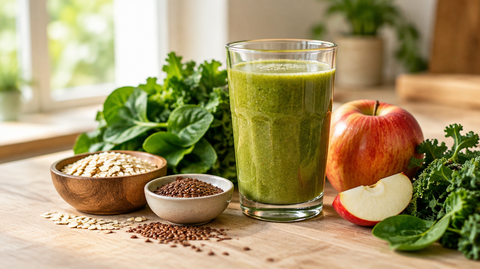
Want to test the principle at home? This green juice is a good start (1 serving):
- 2 stalks of celery
- 1 green apple
- 1 handful of spinach
- ½ cucumber
- 1 thumb-sized piece of ginger
- Juice of ½ lemon
Put everything through the juicer (or blend and strain) and drink fresh. Whether making or buying is worth it, you can read in Press your own juices or buy them?
Conclusion: an honest look
A juice cleanse does not "purify" or "flush the waste out of" your body. Liver, kidneys and gut reliably take care of that anyway, and a "purifying" effect is not scientifically proven. Anyone expecting miracles will be disappointed. The real, honest benefit lies elsewhere: a few mindful days without sugar, alcohol and ready meals, plenty of fluids and micronutrients from cold-pressed juices, and a moment in which you consciously question your eating routine. Many experience exactly that as a refreshing fresh start. So don't see a juice cleanse as a medical cure, but as a mindful break: low-barrier, practical for everyday life and a good push towards lastingly better habits. And if you're unsure or have existing conditions, talk to your doctor first. Ready for your reset? Then find your juice cleanse, from 3 to 7 days.
Frequently asked questions (FAQ)
Is "flushing out waste" scientifically proven?
No. There are no reliable studies showing that cleansing products or cleanses remove harmful substances from the body. Liver, kidneys and gut already take care of metabolism and excretion on their own.
Does a juice cleanse really cleanse the body?
Not in the literal sense. A juice cleanse doesn't purify the body, but it does ease the load: for a few days you go without sugar, alcohol and heavily processed food and give yourself a mindful break.
Can I flush out waste with a juice cleanse?
There are no "slags" in the body. What you feel is the effect of the mindful break and of going without what burdens you, not the elimination of deposits.
How long should a juice cleanse last?
Beginners start with 3 days, the experienced choose 5 or 7 days. Better to start shorter and build up from cleanse to cleanse.
Does a juice cleanse have side effects?
In the first days headaches or tiredness are possible, usually because of giving up caffeine and sugar. If you have existing conditions, check with your doctor first.
Who is a juice cleanse not suitable for?
During pregnancy and breastfeeding, with eating disorders, diabetes, kidney or liver conditions, or if you're underweight, you should skip a juice cleanse or check it with your doctor first.
- Verbraucherzentrale: Article on cleansing products and whether they are worthwhile, verbraucherzentrale.de
- Klein AV, Kiat H. (2015): "Cleansing diets for weight management: a critical review of the evidence." J Hum Nutr Diet 28(6):675-686, PubMed
- Henning SM et al. (2017): "Health benefit of vegetable/fruit juice-based diet: Role of microbiome." Sci Rep 7:2167, Nature
- Deutsche Gesellschaft für Ernährung (DGE): information on fasting, dge.de
Note: This article does not replace medical advice. If you have existing conditions or any doubts, talk to your doctor before doing a juice cleanse.

Nutrition scientist. B.Sc. in nutrition at Weihenstephan-Triesdorf University of Applied Sciences, M.Sc. at TU München. Content Developer Nutrition at aidhere GmbH since 2021. Anna combines nutrition science with practical, everyday recommendations.
More about Anna · annagellert.de · LinkedIn
- The different juices in a juice cleanse
- How long should a juice cleanse last?
- Celery juice & cleansing: what can the superfood really do?
- Flushing out waste: myth or worthwhile? (coming soon)
Many people have worked a juice cleanse into their everyday life or hope that a cleanse after the holidays will steer their body back onto a healthy path. In this post we explain what exactly is meant by a body cleanse and whether a juice cleanse can also be called one.
What is a body cleanse?
Body cleanse is a term for purifying the body. This term is often used in connection with physical cleansing. Because the term is not protected, it is open to free interpretation what exactly is meant by it. In general it is assumed that the body is freed from all kinds of harmful substances such as alcohol, fast food, sweets and also other environmental pollutants. Our body is, however, able to rid itself of harmful substances via the liver, kidneys, gut and skin. An additional cleanse is meant to support the body in this. A body cleanse is about giving up food entirely.

Reasons for a body cleanse
Many people choose a juice cleanse and a body cleanse because of an unhealthy diet or after the holidays, to give the body a fresh start. Besides the physical reset, a cleanse also has the advantage of an inner reset coming along with it. Because a juice cleanse is not only about giving up solid food, it's also about slowing down. The focus is placed on yourself, so stressful situations should be avoided too. Many experience reports show that people feel lighter and better and have more energy. In our last blog post you can also find out what other effects fasting has on the mind.
How much does a juice cleanse purify the body?
Purely scientifically, it can't be proven that a juice cleanse makes the body purify itself. But it can be said that the body cleanses itself during a juice cleanse, above all because during this time no sweets, alcohol, sugar or other harmful substances are taken in. The body still recovers from ballast and frees itself from bad habits. Even if you can't say outright that a juice cleanse purifies the body, it can still help you give up harmful substances in future and lead a healthier life.
How long should I do a cleanse for?
That depends on what you want to achieve with your cleanse. If you simply want to give it a go because you don't know whether it's for you, start with a 3-day juice cleanse. Occasionally the first three days are marked by cleanse symptoms such as headaches or a slight feeling of dizziness. That's why we actually recommend a 5-day juice cleanse. Of course five days require a bit more discipline, but we think: if you're doing it anyway, do it properly. The next level would be a 7-day juice cleanse. On request you can also extend your cleanse to an even longer period.
What are typical cleanse symptoms? Will I have them?
Mild withdrawal symptoms can occur, especially if your body is used to coffee or cigarettes. These may show up as headaches, slight nervousness and occasional dizziness. Skin blemishes can occasionally appear. All of this is a sign that your body is cleansing itself and is therefore welcome. As soon as you order a cleanse, you'll receive a document from us with lots of tips on how to deal with these cleanse symptoms. If they occur at all.