Use your motivation to your advantage!
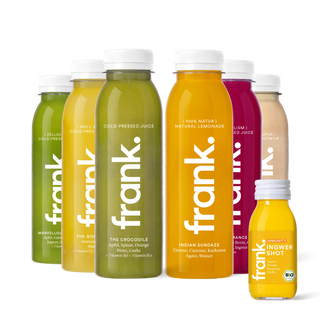
"I fast two days a week. On Tuesday and Thursday I only drink the juices, shots and soups from Frank Juice."
"Why do you do that?"
"I love eating, and not only healthy things. But I know that isn't necessarily good for my body. With regular juice fasting I give my body a break and also save valuable time that I'd normally lose shopping and cooking.
"Do you ever cheat and break the fast because you're so hungry?"
"I'm not hungry at all while fasting. The tasty products from Frank Juice supply me with important nutrients and keep me going. When the smell of pizza drifts into my nose in town, I just think: tomorrow I'm allowed again, in theory."
Motivation and motives
Motivation begins when a certain state is sought or wants to be avoided:
"Hungry? I'll take a look in the fridge."
"Tired? I'll switch on the coffee machine."
These driving factors are called motives.
Some motives are innate, for example eating and reproduction.
Others are learned, like the craving for popcorn at the cinema.
What motivates us, and how strongly, is very individual. The 16 basic human motives vary in strength from person to person.
Motives are so incredibly powerful because acting on the intention activates the reward system. Happy hormones such as dopamine are released. The more often you give in to your craving, the more this mechanism sets in, until the action becomes a habit: you no longer think about whether to get popcorn at the cinema. It's simply a given for you.
If motives are already positively charged, our reward system kicks in in anticipation. You walk into the cinema and the smell of fresh popcorn drifts up your nose? Without being able to control it consciously, your mouth starts watering.
Two types of motivation
Motivation is divided into extrinsic and intrinsic.
This very distinction holds the key to your own behaviour!
Get to know yourself better by finding out which kind of motivation guides your actions. That way you can deliberately train yourself into habits or out of them.
Extrinsic motives
You are extrinsically motivated when the source of incentives comes from outside:
"I exercise so that others admire my body."
"I want to eat healthier to get more recognition from my friends."
"I want to be thinner because my boyfriend likes slim women."
"I make an effort at work to earn more money."
This is exactly the kind of motivation that doesn't last: you'll quickly drop your goals again. That's because your personal willpower isn't strong enough to maintain the behaviour and turn it into a habit.
Intrinsic motives
You are intrinsically motivated when the source of incentives comes from within:
"I exercise to challenge my body, push my limits and forget my everyday worries."
"I want to eat healthier because I only have one body. It's my job to nourish and look after it."
"I want to be slimmer because I want to feel comfortable in my own skin."
"I make an effort at work because the job fulfils me and I see meaning behind what I do."
With this kind of motivation you act out of your own dreams.
That's why intrinsic motivation is so much stronger and more powerful!
Whatever goal you set yourself, always keep your intrinsic motivation in view. Make it visible by writing it down or hanging up pictures.
That way you won't be tempted to give in to short-term impulses, but will keep working towards your bigger, higher-order dreams.
Even during your juice cleanse or your intermittent fasting programme from Frank Juice, this mindset is crucial to remind you of your goal in weak moments and stay steadfast. You don't give up certain foods out of compulsion, but out of your own will to do your body good and give it a break.
Use your motivation to your advantage!
"I fast two days a week. On Tuesdays and Thursdays I only drink the juices, shots and soups from Frank Juice."
"Why do you do that?"
"I love eating, and not only healthy things. But I'm aware that this isn't necessarily good for my body. With regular juice fasting I take the load off my body and also save valuable time that I'd normally lose shopping and cooking.
"Do you ever cheat and break your fast because you're so hungry?"
"I'm not hungry at all while fasting. The tasty products from Frank Juice supply me with important nutrients and keep me going. When the smell of pizza drifts into my nose in town, I just know: tomorrow I'm theoretically allowed again."
Motivation and motives
Motivation begins when a certain state is sought or wants to be avoided:
"Hungry? I'll take a look in the fridge."
"Tired? I'll switch on the coffee machine."
These driving factors are called motives.
Some motives are innate, for example food and reproduction.
Others are learned, like the craving for popcorn at the cinema.
What motivates us, and how strongly, is very individual. The 16 basic human motives vary in strength from person to person.

Motives are so incredibly powerful because acting on the intention activates the reward system. Happiness hormones are released, for example dopamine. The more often you give in to your craving, the more this mechanism becomes entrenched, until the action turns into a habit: you no longer even think about whether to get popcorn at the cinema. It's second nature to you.
If motives are already positively charged, our reward system kicks in in anticipation of them. You walk into the cinema and the smell of fresh popcorn drifts to your nose? Without being able to control it consciously, your mouth starts to water.
Two types of motivation
Motivation is divided into extrinsic and intrinsic.
This distinction is exactly where the key to your own behaviour lies!
Get to know yourself better by finding out which kind of motivation guides your actions. That way you can deliberately train yourself into habits or break them.
Extrinsic motives
You're extrinsically motivated when the source of the incentive comes from outside:
"I exercise so that others admire my body."
"I want to eat healthier to get more recognition from my girlfriends."
"I want to be thinner because my boyfriend likes slim women."
"I push myself at work to earn more money."
This is exactly the kind of motivation that doesn't last: you'll quickly drop your goals again. That's because your personal will isn't strong enough to keep the behaviour going and turn it into a habit.

Intrinsic motives
You're intrinsically motivated when the source of the incentive comes from within:
"I exercise to challenge my body, push my limits and forget my everyday worries."
"I want to eat healthier because I only have one body. It's my job to nourish and look after it."
"I want to be slimmer because I want to feel comfortable in my own skin."
"I push myself at work because the job fulfils me and I see meaning behind what I do."
With this form of motivation you act out of your own dreams.
That's why intrinsic motivation is so much stronger and more powerful!
Whatever goal you set yourself, always keep your intrinsic motivation in view. Make it visual by writing it down or putting up pictures.
That way you won't be tempted to give in to short-term impulses, but will keep working towards your bigger, higher-order dreams.
This mindset is also decisive during your juice cleanse or your intermittent fasting programme from Frank Juice, to remind you of your goal in weak moments and stay firm. You're not giving up certain foods out of compulsion, but out of your own will to do your body good and give it a break.