Updated: October 2026
In short: A banana has about 90 kcal per 100 g; a medium fruit without skin comes to around 100 to 110 kcal. The fruit provides mainly carbohydrates, some fibre and plenty of potassium (approx. 360 mg per 100 g). At a good 12 g of sugar per 100 g, the banana is sweet, but fits into a balanced diet as long as you watch the amount. As of: October 2026.
The banana is Germans' favourite fruit: practical, filling and available all year round. Whether its sugar deserves a bad reputation can be put in context quickly with the numbers below.
How many calories does a banana have?
Per 100 g it's around 90 kcal. Since bananas vary in size, it's worth looking at the portion: a small banana (approx. 80 g without skin) has about 70 kcal, a medium one (approx. 120 g) about 105 kcal, a large one (approx. 150 g) about 135 kcal.
The calories come almost entirely from carbohydrates. Hardly any fat is contained, protein only in small amounts. A piece of banana at breakfast is therefore a quick source of energy, but not a protein supplier.
What nutritional values are in a banana?
The following values are rounded guide values per 100 g of flesh. Depending on variety and ripeness they may deviate slightly.
| Nutrient | per 100 g |
|---|---|
| Energy | approx. 90 kcal |
| Carbohydrates | approx. 20 g |
| of which sugar | approx. 12 g |
| Fibre | approx. 2 g |
| Protein | approx. 1 g |
| Fat | approx. 0.3 g |
| Potassium | approx. 360 mg |
| Magnesium | approx. 27 mg |
| Vitamin B6 | approx. 0.4 mg |
Potassium stands out: the DGE gives an estimated value of about 4,000 mg per day for adults. A medium banana covers roughly 10 percent of that.
Is a banana healthy?
Yes, as part of a varied diet the banana is a good choice. The banana contains potassium, magnesium, vitamin B6 and fibre and can be taken anywhere without preparation.
- Potassium contributes to normal muscle and nerve function.
- Fibre fills you up and supports digestion.
- Vitamin B6 is involved in protein metabolism.
But the banana does not replace variety. The fruit is not a superfood but a solid building block alongside other fruit and vegetables. How you get to the recommended five portions is in our article 5 a day.
Ripe or green banana: what's the difference?
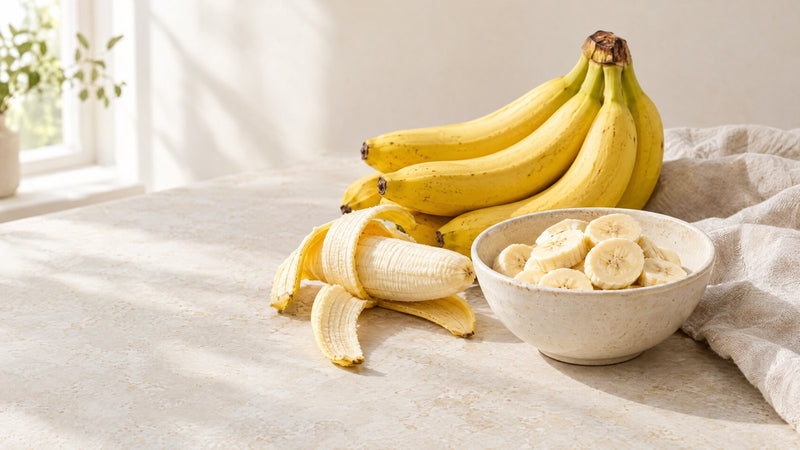
With ripeness, mainly the composition of the carbohydrates changes: green bananas contain a lot of resistant starch, ripe bananas more sugar.
| Ripeness | Properties |
|---|---|
| Green | firmer, less sweet, lots of resistant starch, can cause bloating with a sensitive stomach |
| Yellow | balanced, mildly sweet, easily digestible |
| Yellow with brown spots | very sweet, softer, more free sugar, good for baking and smoothies |
All stages are healthy. If you watch your blood sugar, rather reach for yellow or slightly greenish fruit. If you like it sweet and soft, take the ripe banana.
How much sugar is in a banana?
Around 12 g per 100 g, so about 14 to 15 g for a medium banana. This is the fruit's own sugar, taken in together with fibre, and therefore enters the blood more slowly than the sugar in sweet drinks.
If you eat a lot of fruit, you should keep an eye on the total amount. You can read more on how to put fructose in context in Is fructose healthy?. If you have diabetes, please discuss the amount of fruit with your doctor.
Does the banana make you fat or does the fruit support weight loss?
Neither: gaining or losing weight depends on the overall energy balance, not on a single fruit. A banana has considerably fewer calories than chocolate bars or pastries and fills you up thanks to the fibre.
- Plan the banana as a snack or part of breakfast, not on top of everything else.
- Combine the banana with protein (yoghurt, quark, nuts), then fullness lasts longer.
- One to two bananas a day are unproblematic for most people.
You can roughly estimate your personal needs with the calorie calculator. If you only want to pause briefly with fruit and juices, the juice cleanse offers a structured variant.
Is the banana good for sport and training?
Yes, the banana is a popular snack around training because the fruit provides quickly available carbohydrates and is well tolerated. A banana about 30 to 60 minutes before training gives energy; afterwards the banana together with a protein source helps replenish the stores.
In very long or sweaty sessions, minerals are also lost through sweat. The banana provides potassium but doesn't replace sufficient fluid intake. The banana alone doesn't reliably help against muscle cramps.
Who is the banana less suitable for?
For most people the banana is unproblematic. But there are a few exceptions where you should look more closely.
- Kidney disease: With reduced kidney function, potassium intake can be relevant. Ask your doctor.
- Certain medications: Some blood pressure medications (e.g. potassium-sparing diuretics) affect potassium levels.
- Allergy: Anyone allergic to latex sometimes also reacts to banana (latex-fruit syndrome).
- Fructose intolerance: Here ripe bananas are often less well tolerated than less ripe ones.
How can you eat bananas in everyday life?
Simplest is plain, but there are many variants that improve taste and satiety.
- Sliced onto oats or into muesli, with yoghurt or quark.
- Blended in a smoothie with spinach, berries and a little water or plant drink.
- Freeze overripe fruit and later blend into creamy banana ice cream (nice cream).
- As a natural sweetener in cake: a mashed banana can replace part of the sugar.
Store bananas at room temperature, separate from other fruit, because bananas give off ethylene and make neighbouring fruit ripen faster. In the fridge the skin turns brown, but the flesh is usually still fine.
Matching from frank.
If you also like to drink your fruit now and then: in our Juice collection you'll find cold-pressed juices from fruit and vegetables. That's a practical addition, but it doesn't replace a piece of fresh fruit in everyday life.
You might also be interested in
- 5 a day - how to eat more fruit & vegetables! + nice cream recipe
- Is fructose healthy? What you should know about fructose
- Eating fruit vs. drinking juice - which is healthier?
Frequently asked questions about: Is the banana healthy? Calories and nutritional values
How many bananas a day are healthy?
For most people, one to two bananas a day are unproblematic. What's important is that you also eat other fruit and vegetables.
Can you eat a banana in the evening?
Yes, there is no reason to skip it in the evening. What matters is the total amount you eat over the day.
Why do bananas turn brown?
During ripening, starch converts into sugar and the skin forms brown pigments. The fruit is then sweeter and softer but still perfectly edible.
Does the banana contain a lot of potassium?
Yes, at about 360 mg per 100 g the banana is among the potassium-rich fruits. With kidney disease or certain medications, please discuss potassium intake with your doctor.
Note: This article is for general information and does not replace medical or therapeutic advice. If you have complaints, pre-existing conditions, are pregnant or take medication, please talk to your doctor first.