Updated: October 2026
In short: Rooibos is naturally caffeine-free and contains fewer tannins than black or green tea. It provides antioxidants such as aspalathin and quercetin. According to Medical News Today, though, human research is very limited, with much of it coming from animal and cell studies. To brew: about 2 grams per 250 ml, steep for 5 to 10 minutes. As of: October 2026.
Rooibos, also called red bush tea, is the classic among caffeine-free teas. Here you'll see what's in it, what studies say and how it tastes best.
What is rooibos and where does it come from?
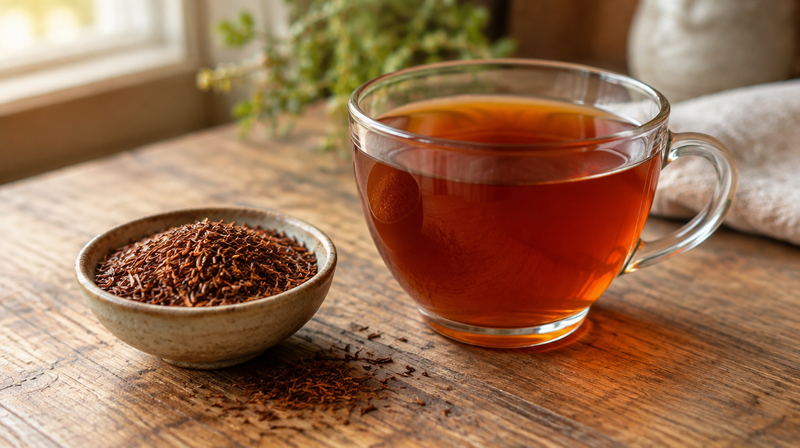
Rooibos (red bush) comes from the plant Aspalathus linearis, which grows in South Africa. The leaves are fermented, which creates the red colour and the slightly sweet, nutty flavour. According to WebMD, it has been drunk there since the 18th century and exported since the 1930s.
Botanically, rooibos isn't a true tea (Camellia sinensis) but an herbal infusion. That's why it contains no caffeine and no theine.
In flavour, rooibos sits between mild and sweet, with hints of nut and wood. That makes it interesting for people who find black tea too bitter. It's sold in bags or loose, and loose leaves usually deliver more aroma. When buying, check the best-before date and store it dry and away from light.
Is rooibos really caffeine-free?
Yes. Rooibos naturally contains no caffeine. That makes it an evening tea and a good choice for people who are sensitive to caffeine. Medical News Today also lists it as suitable during pregnancy. Still, if you're pregnant and in doubt, talk to your doctor, especially with blends containing other herbs.
| Drink | Caffeine | Tannins |
|---|---|---|
| Rooibos | none | low |
| Black tea | contains | higher |
| Green tea | contains | higher |
| Herbal tea, pure | usually none | depends on the herb |
The low tannin content is handy, because tannins can inhibit iron absorption. If you need to keep an eye on your iron, rooibos is often a better choice than black tea.
What's in rooibos: aspalathin and co.?
Rooibos contains polyphenols, including aspalathin and quercetin. Aspalathin is considered a typical compound of the rooibos plant. Healthline and Medical News Today point to antioxidant properties.
There are hardly any vitamins and minerals in the cup. According to WebMD, rooibos contains small amounts of copper, fluoride, potassium, iron, calcium and magnesium. That's no reason to drink it, but no drawback either. A cup without additions has practically no calories.
What effects does rooibos have according to studies?
Medical News Today sums up the situation soberly: research on rooibos is very limited, with much of it coming from animal and cell studies. Studies are looking at the influence on cholesterol, blood pressure, blood sugar and inflammation markers.
| Topic | What was studied | Assessment |
|---|---|---|
| Cholesterol | one study with 6 cups daily over 6 weeks | improvement compared with the control, small body of data |
| Blood sugar | aspalathin in animal studies | anti-diabetic potential, unclear in humans |
| Weight | possible effect on leptin | only indications, no proof |
Healthline explicitly stresses that many health promises rest more on experience than on strong evidence. So rooibos is a pleasant drink, but not a remedy for illnesses.
A practical tip: if you want to drink rooibos because of the cholesterol study, be aware that six cups a day for six weeks is an effort hardly anyone keeps up in everyday life. You don't have to match every amount used in studies. One to three cups as part of a balanced diet is realistic.
How do you prepare rooibos properly?
Allow about 2 grams (a heaped teaspoon) of loose leaves per 250 ml of boiling water. Let it steep for at least 5 minutes. WebMD gives 5 to 10 minutes; steeping longer doesn't make it bitter.
- Hot with lemon or a cinnamon stick.
- Cold as iced tea: brew it strong, let it cool, serve with ice and mint.
- With milk or plant-based drink as a latte.
A worked example: at 2 g per cup, 100 g of rooibos makes 50 cups. That's cheap per cup, but only if you actually drink it and don't forget it in the cupboard.
With loose rooibos, a fine sieve is worthwhile, because the leaves are small and fine. If you use tea bags, you save yourself the straining, but often get a slightly weaker aroma. Warm the teapot or cup briefly beforehand so the temperature stays constant while it steeps.
How do you make a rooibos latte?
A simple recipe if you fancy something creamy without caffeine: brew 2 heaped teaspoons of rooibos strong in 150 ml of hot water and let it steep for 8 to 10 minutes. Warm 150 ml of oat or almond drink and froth it. Pour the strained tea into a large cup, add the foam on top and sprinkle with a little cinnamon.
If you like it sweeter, add half a vanilla pod or a piece of cinnamon stick to the infusion. That gives flavour without needing sugar. With this version you save sugar compared with a sweetened café latte, without giving up the ritual.
Are there side effects or risks?
Rooibos is considered well tolerated. Healthline does mention rare cases in which rooibos was linked to strain on the liver. If you have liver disease, you should have larger amounts of rooibos checked by a doctor first.
Very large amounts or blends can also have effects other than you'd expect. If you take medication, ask at the pharmacy. For healthy adults, the usual amount of one to three cups a day is unproblematic.
Who and when does rooibos suit?
Rooibos suits you if you want something warm without caffeine in the evening, want to avoid tannins or are looking for a mild, slightly sweet tea. It's also an easy replacement for soft drinks if you want to cut down on sugar.
You'll find more on tea in everyday life in Tea for Fasting. An example day: water with lemon in the morning, coffee mid-morning, rooibos with cinnamon in the afternoon, a herbal tea in the evening. That keeps the caffeine limited to the morning.
If you currently drink soft drinks, you can prepare rooibos as iced tea: the evening before, brew a litre strong, let it cool and put it in the fridge. With lemon slices and ice cubes, it's an easy alternative on hot days. After a week, many people notice they hardly miss the sugar. That's based on experience, not a study result.
Pairs well with frank.
We don't stock a tea with rooibos. If you're looking for a low-caffeine alternative, take a look at our Organic Teas: loose herbal teas, 100 g pack from 15 EUR (as of October 2026). Which variety you like is a matter of taste; you'll find ingredients and notes on the respective product pages.
You might also like
Frequently asked questions about rooibos tea
Is rooibos tea caffeine-free?
Yes, rooibos naturally contains no caffeine and is therefore also suitable in the evening.
How long does rooibos need to steep?
At least 5 minutes, up to 10 minutes according to WebMD. Steeping longer doesn't make it bitter.
What is aspalathin?
A polyphenol with antioxidant properties that is considered typical of rooibos. Human studies are limited.
Does rooibos help with weight loss?
It's calorie-free and can be a soft drink replacement. An effect via leptin is being studied, but it isn't proven.
Can I drink rooibos during pregnancy?
Medical News Today lists it as a caffeine-free option. If in doubt, talk to your doctor.
Are there side effects?
Strain on the liver has rarely been reported. If you have liver disease, ask a doctor first.
Note: This article is for general information and does not replace medical or therapeutic advice. If you have symptoms or pre-existing conditions, are pregnant or take medication, please speak to your doctor first.