A little challenge: look back on your last week. How much fruit and veg did you eat each day? Was it really the recommended 5 portions?
Not quite? No worries, with our tips you'll reach the recommended amount every day from now on. Easily, without having to spend ages in the kitchen! We'll tell you what else you can eat besides fruit and vegetables to get to 5 portions a day! And treat yourself to our summer hit: nicecream!
What does "5 a day" mean?
More than 20 years ago, the "5 a day" initiative was launched by experts from science, business and the health sector. The aim was to get people across Germany to eat healthier with a simple nutrition formula. The child's-play formula, which says you should eat five portions of fruit and vegetables spread across the day, is now one of the best-known nutrition rules.
While for many people eating enough fruit and vegetables is a breeze, others find it hard. This is exactly where "5 a day" comes in and shows us how easy it is to establish a healthier lifestyle through healthy snacks and balanced meals.

Why should you eat more fruit and veg?
The "5 a day" rule means that every day you should eat 2 handfuls of fruit and 3 handfuls of vegetables. Fruit and vegetables are rich in nutrients and vitamins, which in turn affect the regeneration processes in our body and influence our metabolism.
If you want to learn more about vitamins, we recommend reading one of our recent blog articles on vitamin D. There we explained in detail the difference between water-soluble and fat-soluble vitamins, and which vitamins you find in certain types of fruit and vegetables.
Did you know that besides fruit and vegetables, pulses (lentils and chickpeas), nuts, oilseeds (flaxseed) and dried fruit also fall under this principle? The reason is that these foods contain a similarly high amount of nutrients as fruit and vegetables. However, keep in mind that the calorie density of nuts, dried fruit and the like is much higher. That is why science recommends limiting the amount to 25 g per portion instead of following the "handful formula".
What's in vegetables & fruit
So what makes fruit and vegetables so healthy?
Fruit and vegetables don't just contain plenty of fibre, they also provide lots of micronutrients, minerals and secondary plant compounds.
Micronutrients support the functions of our body in different ways. On the one hand they support muscle building and help with fat reduction, on the other hand they play an important role in cell division and keep the nervous system working properly.
Minerals like calcium and phosphorus support the build-up and regeneration of our bones and teeth. They are also essential for our immune defence, our muscle activity and our nervous system.
As part of the micronutrients, secondary plant compounds act on neurological processes in our body. They are also said to have anti-inflammatory and antibacterial properties.
While fruit and vegetables are rich in many good nutrients, these foods only provide your body with small amounts of energy and fat. So if you want to lose weight, salads, oven-roasted vegetables and the like are an ideal side dish and can replace carbohydrate-rich foods like potatoes, rice and so on. In everyday life and after tough workouts, we recommend that besides the green sides you also make sure to include a good carbohydrate source, like potatoes or quinoa.
WATCH OUT for a one-sided diet
As with everything, when it comes to fruit and vegetables, too much of a good thing isn't healthy either! Or let's put it this way: too much of just one vegetable or fruit isn't good either! Every type of fruit and vegetable differs in its nutrient content and contains different micronutrients and minerals.
While bananas, for example, are a great source of potassium, magnesium and phosphorus, strawberries also supply iron. And while beetroot is rich in vitamin C, peas are a good supplier of vitamins B1 and B2.
So you see, a monotonous diet is not the be-all and end-all. Make your next fruit bowl or salad plate a colourful one!
Are vegetables healthier raw or cooked?
An important question for us! There is often uncertainty about whether the five portions a day refer only to raw food or whether cooked vegetables count towards the amount too.
We can't confirm the fear that important nutrients in vegetables are destroyed by cooking. Here, too, it depends. In some fruit and vegetables the nutrients are sensitive to heat and get lost, other micronutrients dissolve through heat and pass into the water when cooking, and for yet other nutrients the absorption rate, i.e. the body's ability to take them up, actually improves through heating.
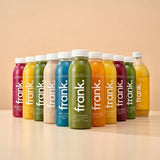
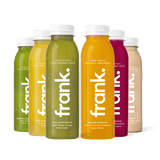
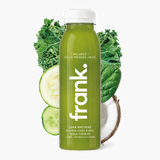
By the way, this is also the reason why we only offer cold-pressed juices ! Classic juices and smoothies in the supermarket are made shelf-stable by pasteurising, i.e. by heat. In the process, important nutrients, minerals and enzymes are lost! For our juicesand juice cleanses we rely instead on a complex high-pressure process (HPP). As a result, no nutrients are lost and our juices still stay fresh for several weeks. So at your home they taste as if they came fresh from the juicer. By the way, this is also why the fruit and vegetables in our juices settle at the bottom. Just give the bottle a good shake before drinking!
Here are a few examples of which vegetables you should rather enjoy raw or cooked!
Better eaten raw...
- Peppers- The nutrients in the pod can't withstand high heat.
- Garlic - This allium contains lots of good nutrients, such as allicin, a compound that scientific studies suggest may play a role in supporting health. Garlic's nutrients are lost when cooked, though.
- Courgette- Ever tried it raw? Raw, this vegetable is rich in vitamin C and iron. Caution is advised, though. If the courgette tastes bitter, it may point to harmful substances. Then it is neither edible raw nor cooked and can cause stomach problems.
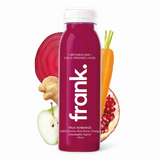
- Beetroot- The tuber contains vitamin B, potassium, iron and folic acid. Folic acid in particular is essential for cell division and the formation of new cells. Heat destroys the folic acid in the tuber, and its positive effects along with it. One reason why our favourite True Romance with a proper portion of beetroot is a real banger!
Better enjoyed cooked...
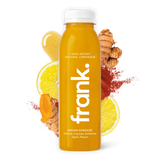
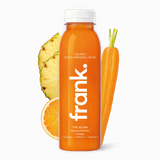
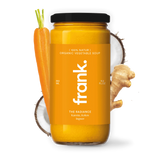
- Carrots- While raw carrots are rich in vitamins B2 and B6, cooking releases beta-carotene, a precursor of vitamin A. Vitamin A is important for heart health, helps against inflammation and helps against oxidative stress. You can find raw carrots in our tasty juice Orange. If you value the nutrients released through cooking, you should definitely try our frank.carrot ginger soup !
- Tomatoes -In tomatoes and red fruits like rosehips, heat releases the compound lycopene. It is one of the antioxidants. Antioxidants fight harmful radicals in the body and neutralise them. At frank we cook tomatoes down in our creamy organic tomato soup!

How to manage five portions of fruit and veg?
Now you may be wondering how you are supposed to get your five portions of fruit and vegetables every day despite a full diary and leisure activities?
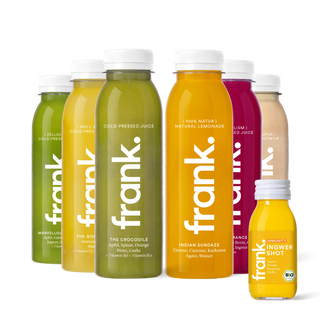
One option, for example, is to take in nutrients in liquid form. Especially on hot days, cold-pressed juices are perfect as a snack in between! Unlike ready-made smoothies and pasteurised fruit juices, cold-pressed juices still contain all the nutrients after processing.
Or swap your jam sandwich in the morning for a creamy protein shake. Along with oats, plant milk and vegan protein powder , add a few dates, fresh berries, flaxseed and some nut butter, and your shake becomes a full meal. In our frank.Protein Shake Guide you'll find 20 recipe ideas to bring more variety to your morning shake!
Besides the tips above, you can always take a box of cut fruit and vegetables to work or on trips. A colourful, varied snack box will make you forget your sweets drawer quickly, and in the evening you can enjoy a pizza with a clear conscience.
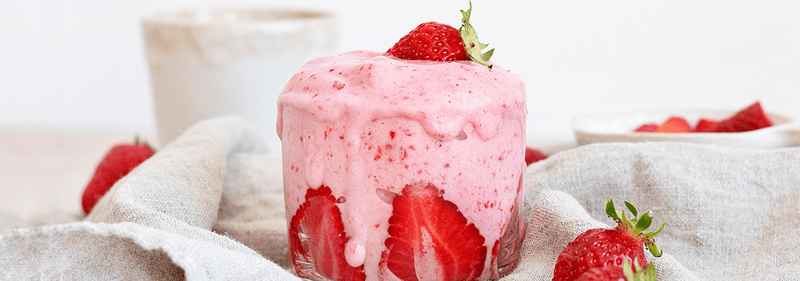
Last but not least, we have our ultimate summer hit for you! Nicecream instead of ice cream! We show you how the sweet refreshment works in our recipe!
Nicecream instead of ice cream - the better ice cream!
Fancy a tasty ice cream but want to skip unhealthy ice cream creations? Then nicecream is your next summer hit! You can make this ice cream from delicious fruit in a few minutes with your favourite fruit. For a creamy texture, add a little plant milk. That way your ice cream even stays vegan!
For our recipe, instead of classic plant milk we used our tasty juice Mister White The banana fits the recipe perfectly, and cinnamon and vanilla give it a uniquely delicious taste!

Ingredients:
- ½ bottle of our almond milk Mister White
- 1-2 ripe, frozen bananas (depending on size)
- 150 g strawberries, frozen
- 1 handful of fresh strawberries
Preparation:
Blend our banana almond milk White with the frozen strawberries. Cut half of the fresh strawberries into thin slices, use them to decorate the inside of the glass, fill in the nicecream and garnish with the rest of the strawberries.
Enjoy cold or keep in the freezer for later!
Enjoy!