





























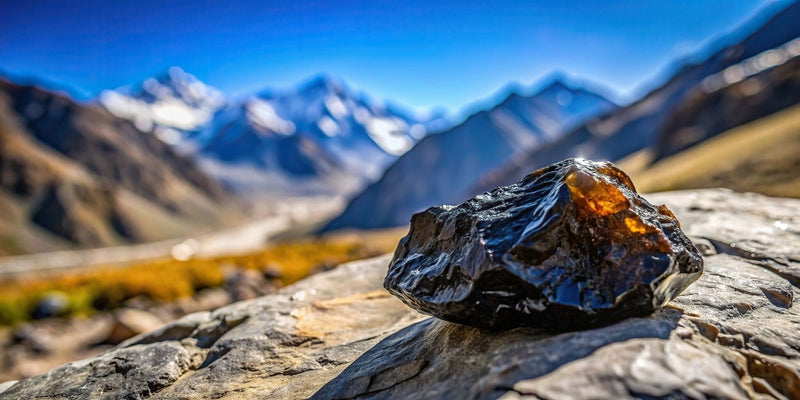
There's a widespread assumption that the most important foods are already known and thoroughly researched. The truth is a little different. The best example of a little-researched substance with a high nutrient content is mumijo.
Mumijo (also called shilajit) is a fixture of Ayurvedic medicine. It is also highly regarded across Asia in general. Mumijo/shilajit is said to have a wide range of positive effects on human health .
We asked ourselves: does this substance, which many websites call a miracle remedy, live up to expectations? We share our findings with you in the article below.
Mumijo: the key facts at a glance
• Colour: mostly black, sometimes brown and very rarely other colours
• Appearance: usually a thick, sticky consistency, similar to asphalt
• Smell: resin-like
• Taste: slightly bitter
• Ingredients: a large amount of trace elements and minerals
• Use: a fixture of Ayurvedic medicine as a traditional natural remedy, often used as a food supplement here in Germany
• Origin: mountains and rock faces (mainly the Himalayas, Altai, Caucasus and Sinai)
• Names: mumijo, shilajit, Asphaltum punjabinum, Barachschin (oil of the mountains), Brogschaun (mountain juice), Arakul dshibal (mountain sweat)
Mumijo is a natural product found in places with long, strong sunshine. It is also considered scientifically established that the air has to be clean and a certain type of plant growth has to be present for mumijo to form.
So far, mumijo deposits have only been found in the mountains and on rock faces. The black gold, as mumijo is called because of its high standing in Ayurvedic medicine, forms above all in the Altai and Caucasus mountains and, in smaller amounts, in the Himalayas.
Ingredients of mumijo/shilajit: potentially far-reaching benefits
The resin-like natural product mumijo contains numerous ingredients that are essential, or at least helpful, for the human body. Among the essential ingredients in mumijo are minerals and trace elements. With more than 80 minerals and trace elements, mumijo is one of the most nutrient-rich substances in the world. The minerals include, for example:
-
Zinc: It plays an important role in metabolism, among other things. This mineral also contributes to normal fertility.
-
Magnesium: This mineral contributes to the reduction of tiredness and fatigue. It also has other essential functions.
-
Iron: It contributes to normal cognitive function and to the normal formation of red blood cells and haemoglobin. This mineral has other functions too.
Besides minerals and trace elements, mumijo contains humic acids and fulvic acids. Both humic and fulvic acids are said to have a positive effect on nutrient absorption. The acids are also said to help the body get rid of toxins. However, there are no studies or other scientific evidence that the acids actually have such an effect.
Regardless of how effective the acids are, the wide range of minerals and trace elements alone gives mumijo many health benefits. Taking mumijo is accordingly widespread in the traditional medicine of many Central Asian cultures. In Central Asia, where mumijo forms in the mountain regions, there have been legends about mumijo/shilajit as a remedy and tonic for thousands of years.

Using mumijo: digestive tract, bones, inflammation and more
Practitioners of Traditional Chinese Medicine (TCM) use mumijo, among other things, as a traditional remedy for digestive complaints and to strengthen the kidneys. This natural remedy also has a tradition of use for inflammation and bone complaints. For example, a broken bone is said to heal faster when taking mumijo, and other bone complaints are said to ease.
Given the minerals and trace elements in the natural product, the use of mumijo in Central Asian cultures sounds plausible. For example, we know that magnesium, which is a component of mumijo, contributes to the maintenance of normal bones and teeth. By meeting their daily magnesium needs, people can help protect themselves against various bone problems.
Given the high content of various minerals, there are further areas where mumijo could be used. For example, the natural product may support the immune system and supply the brain with the minerals it needs for high performance.
However, the information about the potential mode of action and benefits of mumijo is only theory. In practice, things look different in Germany: because of the lack of scientific evidence and its low profile here, mumijo is hardly used in Western medicine. That is partly because there are hardly any studies on the effects of mumijo, and partly because mumijo is mostly only available here as a modified food supplement.
Studies so far on the supposed natural remedy
The current research on the natural product mumijo shows promising results and points to numerous health benefits. Even though more research is needed to understand the full extent of the positive effects, users may benefit from the potential advantages. So far, the following studies on the effects of mumijo have been carried out, among others:
• Study by Goel et al. on the effects of mumijo in relation to arthritis and ulcers
• Study by Shahrokhi et al. on the effects of mumijo in relation to stomach complaints
• Study by Sharma et al. on the effects of shilajit on blood lipid levels
• Study by Biswas et al. on the effects of shilajit on fertility and sperm quality
Europe has strict rules for health claims, so we communicate these benefits responsibly.
An alternative to mumijo supplements
An alternative to buying mumijo supplements is to buy pure mumijo from the mountain regions of Central Asia. Some producers offer the pure natural product. However, because of the laborious "harvest" and its long maturing process of at least 20 years, it comes with a hefty price tag.
At frank., we make our own food supplements and natural juices that offer several benefits for your health thanks to the vitamins, minerals, trace elements, antioxidants and other ingredients they contain. Why not find out more about our 7 day food cleanse! You'll also find specially put-together bundles with us, such as our gut cleanse set, a set for your immune system and our heartburn bundle.
About the possible side effects of mumijo
Because of its high content of various minerals, taking mumijo can lead to overdosing. An overdose can cause side effects such as tiredness and headaches , which are exactly the effects you'd hope to avoid thanks to the positive effects of mumijo or shilajit.
Because of its properties and the substances it contains, pregnant women and people with pre-existing kidney or liver conditions should see a doctor before taking natural mumijo or a food supplement containing mumijo. The doctor can then advise whether, and in what amount, taking mumijo is safe.
Although pure mumijo from nature has a better composition and better properties than mumijo supplements, pure mumijo has one problem: because of the low national standards for mining it in the various countries, it is prone to impurities that can harm human health.
Outlook: a substance with potential for the future
Modern European medicine is becoming more and more open to traditional approaches from other cultures. For example, some European doctors and clinics already include the teachings of TCM and Ayurveda in their practices and therapies.
This is where black gold comes into play. Thanks to its immense range of minerals and trace elements and other substances that are good for health, the potential of mumijo or shilajit is enormous in Western medicine too.
It remains to be seen what happens once the modes of action and side effects of the natural product mumijo are scientifically proven by solid studies. Anyone who already believes in the effects of mumijo can start taking it themselves and see whether they notice any effects or not.
FAQ about mumijo and shilajit
In the following section, we've put together some helpful questions and answers about mumijo. They briefly sum up the article and equip you with the most important information on mumijo and shilajit.
What is the difference between shilajit and mumijo?
There is no difference between shilajit and mumijo. Both are names for one and the same natural product: a resin-like substance that forms mainly in the Altai, Caucasus and Himalaya mountains. Besides shilajit and mumijo, there are also names such as "black gold" and "sweat of the mountains".
How is mumijo made?
Natural mumijo isn't made, it forms by itself, and the exact process of how it forms is unclear. The most popular theories argue for a purely plant-based origin. Since 1995, the scientific consensus has been that mumijo is a metabolic product of microorganisms that forms when plant remains break down. The term "humus" often comes up here, which points to a kind of compost formation.
How long can you take mumijo?
The properties of mumijo vary depending on where it is mined. Given the different properties of the substances and the varying composition, it's not possible to say clearly how long you can take mumijo. In principle, there is nothing against taking mumijo daily, as long as you have no pre-existing conditions and aren't pregnant. Regardless of the intake cycle, however, you must make sure that mumijo is taken in a way that doesn't lead to an overdose of the minerals in its composition.
Want to give your body a conscious break and recharge with new energy? Discover the juice cleanse from frank., a gentle reset for body and mind.


